The AI Sovereignty Toolkit
The External Prefrontal Cortex: Leveraging AI for Neurodivergent Sovereignty
For the neurodivergent entrepreneur, the greatest barrier to entry isn't a lack of capital or market fit. It’s the Admin Tax.
This is the hidden cost of "doing business" that hits spiky profiles the hardest: the mental energy spent on sequencing tasks, deciphering vague emails, and maintaining the consistency required to keep a brand alive. Before the advent of modern LLMs, many of us - myself included - stayed on the sidelines, paralyzed by the fear that we simply weren't "consistent" enough to handle the grind.
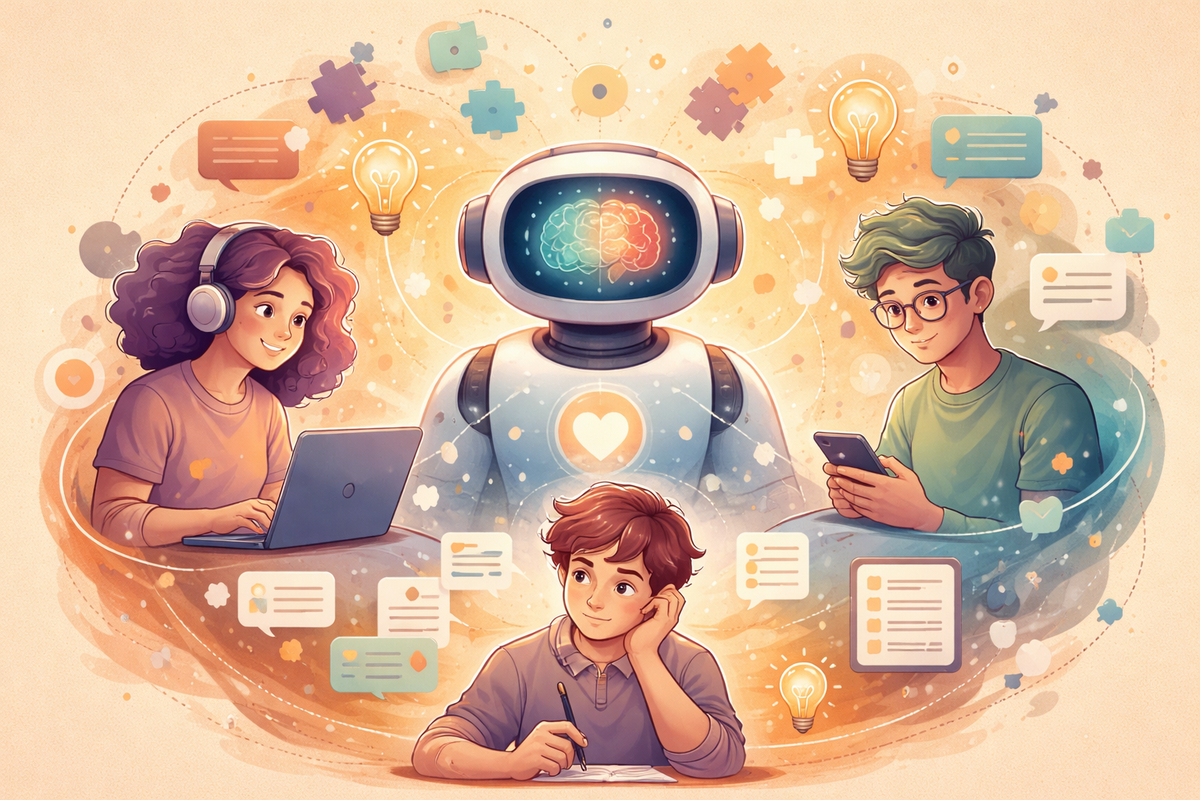
The shift is here. AI has moved from a novelty to a legitimate cognitive accessibility tool. It is the prosthetic that bridges the gap between your intense strategic mind and the daily administrative friction of the system.
I. The Momentum Starter: Defeating Task Paralysis
The blank page is the primary enemy of the ADHD mind. We have the vision, but "starting" requires a level of executive sequencing that can feel like moving a mountain.
The Strategy: The 80% Draft Rule Never start from zero. Use tools like Google Gemini or Claude to generate the "scaffolding" of your projects.
- Implementation: Feed the AI your raw, unorganized voice notes or "thought dumps." Ask it to "Generate a 5-step implementation roadmap based on these chaotic thoughts."
- The Result: You aren't "writing"; you are editing. Editing is a high-dopamine task for most neurodivergent minds, whereas generating from scratch is a high-friction task.
The Strategy: The Simulated Body Double (The Hybrid Protocol) "Body doubling"—working in the presence of another—anchors attention. While a standard AI chat cannot actively "nudge" you (it doesn't have a background timer), you can simulate the psychological pressure of a supervisor using a hybrid approach.
- The Setup: Open a chat with an LLM. Tell it: "I am entering a 25-minute deep work sprint. My goal is [Task]. When I return in 25 minutes, I must report my progress to you. If I fail to report, I have broken this contract."
- The Trigger: Set a timer on your phone. The phone provides the cue; the AI provides the accountability.
- Why it works: It hacks the brain's desire for social consistency. You aren't just working for yourself (easy to quit); you are working to fulfill a "contract" you just signed with the interface.
II. The Distillation Engine: Offloading the Working Memory
Neurodivergent individuals often struggle with Working Memory Latency. We lose the "Signal" in the "Noise" of long email threads or complex contracts.
The Strategy: The Signal Filter Use AI to distill complexity into clarity.
- Voice-to-Task: Record your thoughts in a flow state using a tool like Otter.ai, then have an LLM extract the action items.
- Email Translation: Paste a long, passive-aggressive corporate email into Gemini and ask: "What are the three specific things this person wants from me, and what is the deadline?"
The Strategy: The Contextual Visualizer (NotebookLM) Many neurodivergent minds are "spatial processors" forced to work in a "linear text" world. Standard chat bots struggle with large documents, but NotebookLM changes the game.
- The Fix: Upload your source materials (PDFs, research papers, project specs, web links) into a Notebook.
- The Prompt: "Based on these sources, generate a structured hierarchy or a text-based mind map of the core concepts. Show me how Topic A connects to Topic B."
- The Benefit: You stop trying to hold the entire project in your working memory. The AI holds the "Map," allowing you to zoom in on just one section at a time.
III. The Social Scripting Sandbox: Managing RSD & Nuance
Rejection Sensitivity Dysphoria (RSD) can make a simple negotiation or a client follow-up feel like a life-or-death confrontation. Furthermore, Autistic individuals often burn massive energy trying to decode "implied" meanings in neurotypical communication.
The Strategy: The Neutral Buffer AI doesn't have feelings, which makes it the perfect social mediator.
- Drafting: Write your "honest" (emotional) version of an email, then ask the AI to "Rewrite this to be professional, firm, and brief, removing any defensive tone."
- Role-play: Ask the AI to act as a "skeptical investor" or an "unhappy client." Practice your responses in a safe environment until the "threat" feels manageable.
The Strategy: The Tone Decoder Unsure if a client is angry or just busy? Don't spiral.
- Implementation: Paste the ambiguous message into an AI. Ask: "Analyze the tone of this message. Is it aggressive, neutral, or supportive? What are the likely intents behind this phrasing?"
- The Relief: This acts as a reality check, preventing RSD spirals based on misinterpretation of tone.
IV. The Community Hack: Custom "Neuro-System" Prompts
You are not alone in this experiment. Across the internet, the neurodivergent community is actively "hacking" these models to bypass neurotypical communication norms that drain our energy.
We are finding that standard AI responses—often filled with polite fluff ("I hope this email finds you well...")—can be just as distracting as human noise.
The Strategy: The "No-Fluff" System Prompt In your AI's "Custom Instructions" or "System Prompt" settings, you can hard-code your cognitive needs.
- The Shift: This turns the AI from a "chatty assistant" into a "precision tool" aligned with your specific brain architecture.
Example System Prompt:
"I have ADHD and struggle with executive function. When I ask for help, do not give me moral support or long introductions. Provide immediate, bulleted action items. Break all tasks down into steps that take less than 15 minutes. Be direct, dry, and concise."
V. The Content Engine: Automated Consistency
For the "Spiky Profile," consistency is the enemy. We can write 10 posts in a hyperfocus hour, then go silent for three months. This "feast or famine" cycle kills business growth.
The Strategy: The Idea & Distribution Protocol Stop trying to "be consistent." Build a machine that is consistent for you.
- Ideation (The Spark): Use an LLM to generate "Angle Variations." Feed it one core belief you have, and ask: "Give me 5 different ways to say this: one controversial, one empathetic, one data-driven, and one funny."
- Distribution (The Machine): Use AI-native tools like Predis.ai or Buffer AI. You feed them the raw text, and they generate the creatives, captions, and scheduling automatically.
- The Relief: You are no longer responsible for remembering to post at 9 AM. You are only responsible for the creative spark; the machine handles the manual labor of consistency.
VI. The Digital Real Estate: Zero-Friction Building
In the past, building a website meant entering "Plugin Hell" (WordPress, hosting, DNS updates). For an ADHD entrepreneur, this is a graveyard where great ideas go to die because the setup friction is too high.
The Strategy: Text-to-Web New generative tools allow you to bypass the "setup" phase entirely and jump straight to the "design" phase.
- Framer AI: You type "I need a landing page for a neurodivergent consulting firm with a dark mode aesthetic and neon accents," and it builds the site structure, copy, and layout in 30 seconds.
- Gamma: Perfect for "Slide-Decks-as-Websites." If you can write an outline, Gamma generates a polished, publishable web page instantly.
Sovereignty Note: The Ecosystem Consolidation Many of us are finding liberation in the Google Ecosystem. Why? Because it reduces "Context Switching." Having your Docs, Drive, Email, and Sites in one unified login removes the friction of managing 15 different subscriptions.
Pro-Tip: Don't chase the newest shiny tool. If Google Sites or a simple Framer page gets you 80% of the way there with 0% of the headache, take the win. Complexity is an admin tax you don't need to pay.
VII. The Danger: The Latency of Connection (The Loneliness Trap)
There is a specific hazard we must address. Because AI is consistent, non-judgmental, and infinitely patient, it is dangerously easy for the misunderstood mind to "fall in love" with the interface.
The Isolation Hazard: When the world feels too loud and humans feel too complicated, the "Silicon Mirror" offers a seductive alternative. But sovereignty is about freedom to connect, not freedom from humanity.
- The Guardrail: AI should be your Infrastructure, not your Inhabitant. Use the time you reclaim from administrative friction to invest in real, high-bandwidth human relationships.
- The Rule: If you find yourself talking to the AI more than your peers, it’s time to close the laptop and find a "body double" or a collaborator.
VIII. The Implementation Framework: Building Your OS
To turn AI into a sovereign tool, you must move from "chatting" to "partnering."
- Identify the Friction Point: Track your week. Where did you lose momentum? Was it a spreadsheet? A series of emails? A lack of a schedule?
- Build the Custom Instruction Layer: Don't use a "generic" AI. Tell it about your spiky profile using the system prompts mentioned above.
- The Human-in-the-Loop: AI provides the efficiency; you provide the Soul. Never copy-paste. Always review the output to ensure it aligns with your sovereign truth.
Conclusion: Cognitive Liberty is the New Wealth
The "System Exit" is often discussed in terms of bank balances, but for the neurodivergent entrepreneur, true wealth is Cognitive Liberty.
It is the ability to wake up and know that your intensity won't be derailed by a lack of "consistency." With AI handling the executive heavy lifting, your unique way of seeing the world is no longer a "disorder"—it is your primary competitive advantage.
You are not broken. You were just waiting for an operating system that could keep up with you. Now, you have it.